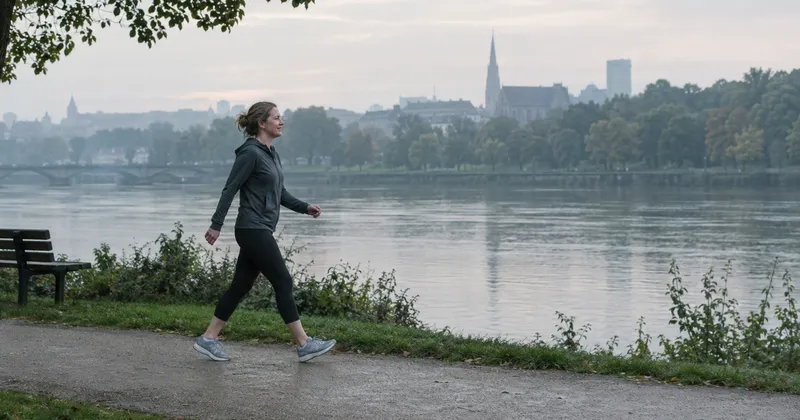
Brisk walking counts as exercise when it leaves you a little out of breath but you can still speak in short sentences12. It's not about whether you have sports shoes or how many steps your watch shows, but how you feel while walking. Below you'll find a simple test, a rough pace guide, and ways to fit it into even a packed day.
Key points
- Brisk walking is moderate-intensity exercise: you get a bit out of breath, but you can still talk, though singing would be too much13.
- As a rough guide, it's around 100 steps per minute, but that's a guideline, not a fixed threshold45.
- You don't need any equipment or training, just ordinary walking at a slightly quicker pace.
- The H7 White Belt is 9 minutes of movement a day, and you can easily get that on your way to work or to lunch.
- A stroll to the bakery is nice, but it doesn't count toward H7, because it doesn't leave you out of breath.
How to tell if you're walking fast enough: the talk test
The simplest gauge is always at hand. It's your breathing. During moderate-intensity walking, you can tell you're moving more than when you're just ambling along.
The talk test can help:
- Can you sing without any trouble? The pace is still too slow. Speed up.
- Can you exchange a few words, but a continuous story would be a struggle? You're exactly where you want to be.
- Can't say even a sentence without pausing for breath? That's too much for a start. Slow down, nobody's judging you.
The talk test has proven useful for healthy adults as well as for people with cardiovascular disease, and it's guided by your own fitness, not a chart3. The same pace can feel like a stroll to one person and a real workout to another. Both are right.
How many steps per minute is brisk walking
If you like to measure, you can check your pace in numbers too. A commonly cited guideline for moderate-intensity walking in adults is roughly 100 steps per minute or more45. These are only approximate values, though. It depends on age and fitness, so you'll get out of breath sooner going uphill than on flat ground67.
How to find your pace in a minute
- Set off at a brisker pace, as if you were hurrying somewhere but didn't want to break a sweat.
- After a few minutes, start counting steps (counting just your left foot is enough) for 30 seconds and multiply the result by four.
- Check your breathing with the talk test. If your breathing fits, the number is just a bonus.
Treat the number as a guide, not an exam. More important than exactly 100 steps is that you get a little out of breath and can keep it up.
Why ordinary walking is enough
Exercise doesn't have to be complicated. Walking is natural and accessible, and people without contraindications usually don't need a medical check-up before starting brisk walking8. In its 2020 recommendations, the World Health Organization advises adults to do 150 to 300 minutes of moderate-intensity activity per week8. Brisk walking falls into this category.
Large studies link more physical activity with better health, but they show an association, not a guarantee910. That's why we don't promise miracles. We only promise that every additional step counts and that fitness can be improved81. If you have a health condition or you're not sure how much strain you can handle, go over it with your doctor first.
How to fit brisk walking into your day
The best walk is the one that fits into your regular day. You don't have to block out an hour in your calendar right away.
Ideas that work
- Commuting to work or school. Get off one stop early and walk the last stretch briskly.
- Lunch with movement. Instead of sitting at your desk, take 10 minutes of brisk walking around the building.
- Phone calls on your feet and on the move. Take any call where you don't need to write anything down while walking.
- Stairs instead of the elevator. Stairs are an easy opportunity to add a bit of extra movement to your day.
- An evening loop. A short brisk circuit around your neighborhood is a good way to add movement after a demanding day, and it can quickly ease feelings of anxiety1.
Start with whatever suits you best. Once it becomes a habit, add another bit.
Brisk walking and the H7 White Belt
In H7, you start at the White Belt, which is 9 minutes of movement a day. That adds up to 63 minutes a week. The goal is 7 hours a week, but that's a goal, not an entry requirement. Each additional belt adds an hour a week, and everyone who starts can go at their own pace.
Brisk walking is an ideal choice for getting started. You don't need to buy anything, you don't have to travel anywhere, and after nine minutes you're done. If it leaves you a little out of breath and you can still talk, it counts. If you're just ambling along and looking at shop windows, it's a pleasant walk, but it doesn't count toward H7.
In the app you'll find more options, with a catalog of over 60 activities. You can alternate walking with cycling, swimming, or dancing, depending on what you enjoy. The H7 app is free and you can find it at join.h7active.com/app.
Next time you head outside, try the talk test. You may find that you've been getting your nine minutes a day for ages, you just weren't counting them.